
How to Check Criminal History in Binghamton
Begin with the event, not with a broad name query. The Binghamton Police Department holds its own incident and arrest reports, while Binghamton City Court keeps misdemeanor, violation, and preliminary felony files. A felony trial belongs to Broome County Court. The New York State Office of Court Administration Criminal History Record Search, or CHRS, can identify public court matters across New York, but it is not the same as a fingerprint-confirmed DCJS rap sheet.
- Ask Binghamton Police or the City Clerk for the specific incident or arrest report, using a date, place, report number, and full name when known.
- Request the city record through the Binghamton FOIL channel when the Police Records Bureau cannot release it at the counter.
- Contact Binghamton City Court for a known misdemeanor, violation, traffic matter, or preliminary felony docket.
- Move to Broome County Court for an indicted felony, and use the county jail inquiry line when the question is current custody.
- Use OCA CHRS for a statewide public court search or DCJS Personal Record Review for a fingerprint-based copy of your own New York record.
This Binghamton route prevents a common error: treating one useful document as a complete Binghamton criminal history. A Binghamton police report records an agency event. A Binghamton docket tracks what a court did. A certificate of disposition states the result of a specific Binghamton case.
Binghamton Police Records Bureau Volume
Binghamton Police reported that four civilian Records Bureau staff processed 54,852 incidents during 2025. That total included 1,853 non-criminal domestic incidents and about 2,180 record requests. The bureau also carried out sealing work for 272 adult arrests and 163 juvenile arrests. Those figures describe the workload behind a Binghamton records request, not the number of crimes or people charged.
The Binghamton bureau preserves department activity in paper and electronic form, supports daily crime analysis, supplies required disclosure to prosecutors, reports Binghamton data to the state, and applies court sealing orders. A Binghamton request that names the kind of record and narrows the date range gives staff a better path than an open-ended demand for every mention of a name.
The Binghamton Police Department
The Binghamton Police Department has held New York accreditation since 1993. Its Records Bureau maintains reports created by BPD, including incident and arrest material, and its public hub posts annual reports, arrest reports, policies, and monthly crime maps. The bureau does not become the custodian of Sheriff, State Police, or court records simply because the event occurred in Binghamton.
Binghamton FOIL requests route through the City Clerk at 38 Hawley Street during weekday business hours. Binghamton paper pages no larger than 9 by 14 inches may cost up to 25 cents each, while other reproduction may be charged at actual cost. The request should state the Binghamton incident date, location, people involved, report number if known, and the part of the file sought. Active investigations, protected personal details, sealed matters, and material that could endanger someone may be withheld or redacted.
Binghamton Criminal Records and Crime Maps
BPD’s monthly maps sort reported incidents into seven categories: assault, larceny, burglary, motor-vehicle theft, rape, robbery, and murder. The maps can show where and when a reported category clustered during a month. They cannot identify a person’s Binghamton criminal history, prove that an arrest followed, or show whether a prosecutor filed a charge.
Use a Binghamton map for neighborhood and time-based context. Use the Binghamton Records Bureau for a specific police report, and use the court clerk for a filed case. This distinction is vital because Binghamton law-enforcement coding supports analysis and state reporting, while a court record documents allegations, appearances, rulings, and disposition. An aggregate point on a Binghamton map should never be read as a conviction record.
Arrests and Bookings in Binghamton
Binghamton has no city inmate roster. After a BPD arrest, custody and booking information move through the Broome County Sheriff’s Correctional Facility and the Centralized Arraignment process. For present custody, call the Sheriff at 607-778-1911 and select option 2. The Sheriff’s mobile app and New York VINE offer added custody and notification routes, but neither turns a Binghamton police report into a court disposition.
A recent Binghamton arrest may appear first in BPD material, then in a jail record, and later in City Court. If a Binghamton felony is indicted, the trial-level file moves to Broome County Court. The Broome County arrest-history channel explains the county process in more depth, while a local Binghamton report still must come from the agency that made the arrest.
Timing differs across those Binghamton systems. Booking data can change after release or transfer, and a Binghamton court file may not yet contain a final outcome. Confirm the present Binghamton status with the custodian that owns that stage.
Binghamton Body Camera Record Requests
BPD Policy 422 treats body-worn camera recordings as official police records. A person seeking footage should use the city FOIL process and describe the event closely: date, approximate time, location, officers or report number if known, and the segment requested. Police Administration reviews release and applies lawful redactions or withholding rules.
Binghamton body-camera video can contain faces, voices, medical facts, home interiors, witness statements, and details of an active investigation. A valid Binghamton request therefore does not guarantee an unedited copy. Ask for the Binghamton incident report as a separate record when it will help identify the correct footage. If Binghamton denies access, its written response should state the basis and explain the FOIL appeal route.
Note: A body-camera recording documents an encounter; it does not establish the final result of a Binghamton criminal case.
Binghamton Municipal Court Records
Binghamton uses a City Court, not a court formally titled “Municipal Court.” The criminal counter is at 38 Hawley Street on the fifth floor and is open weekdays from 8:30 a.m. to 4:30 p.m. The clerk can be reached at 607-240-4272. City Court hears misdemeanors and violations, manages traffic matters, and handles arraignment or preliminary work on felony complaints. Broome County Court alone conducts local felony trials.
| Court Name | Binghamton City Court, 38 Hawley Street, fifth floor |
|---|---|
| Case Types Heard | Misdemeanors, violations, traffic matters, and preliminary felony proceedings |
| Case Lookup Channel | Known-case request at the clerk; OCA CHRS may identify public reported matters |
| What the Docket Shows | Case number, charges, appearances, rulings, status, and disposition when public |
| Copies & Fees | A certificate of disposition costs $5; confirm other copy costs with the clerk |
The official Binghamton City Court source also provides calendars, remote-appearance details, payment information, and a disposition-request form. Its screen below helps identify the correct court contact, but it is not a public citywide name-search portal.
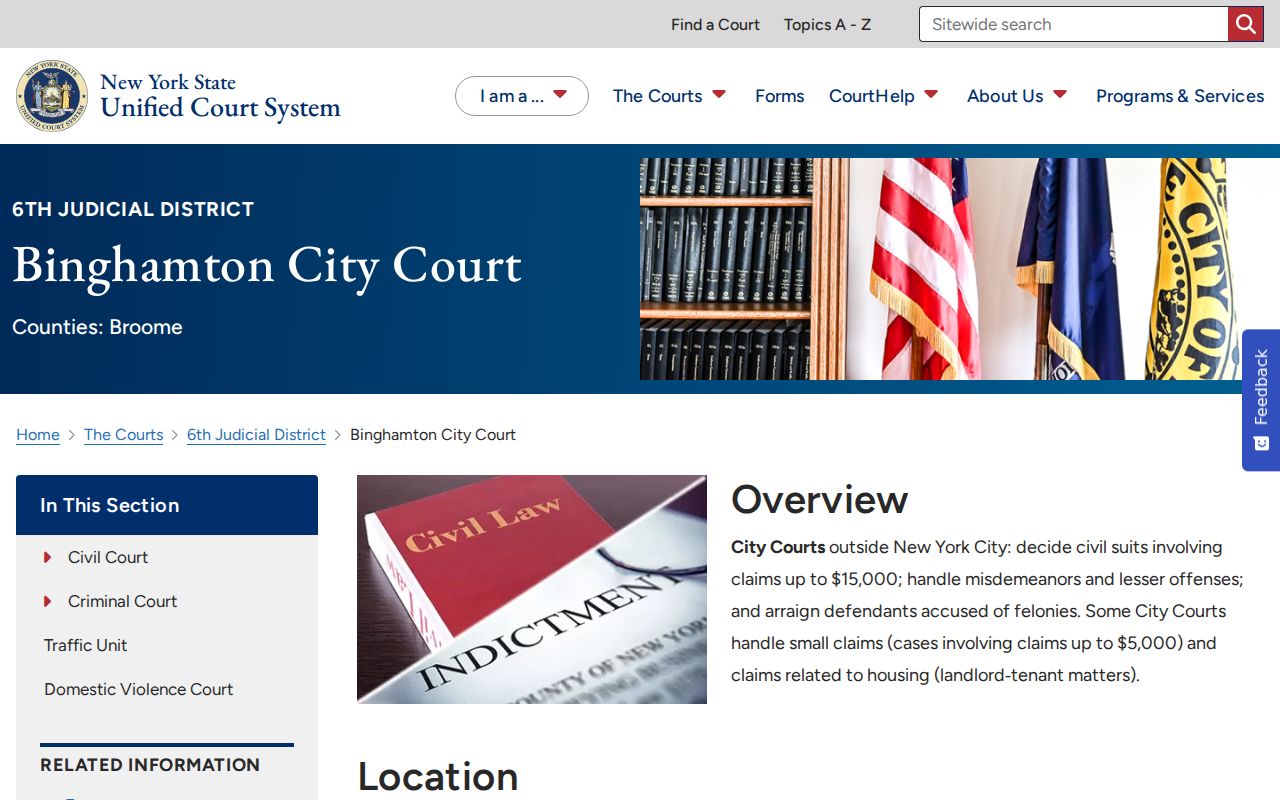
The Binghamton court page is most useful after the requester knows that City Court owns the file. A Binghamton felony indictment or trial record belongs across Hawley Street at County Court.
Binghamton Records at Two Hawley Counters
The same street name can hide a large custodial divide. City Hall and City Court operate at 38 Hawley Street, while Broome County Court operates at 65 Hawley Street. A BPD report request goes through city channels. A City Court case stays with the fifth-floor clerk. An indicted felony belongs to County Court, even if BPD made the first arrest.
| Record | Starting Point | What to Bring |
|---|---|---|
| BPD incident or video | City Clerk or Police Records Bureau | Date, place, report number, and precise description |
| City criminal docket | Binghamton City Court | Name, date of birth, docket or ticket number |
| Felony trial file | Broome County Court | Defendant name and indictment or case number |
Do not ask the County Clerk for an undifferentiated Binghamton background search. Broome’s own records guidance says Binghamton lower-court files may remain at the municipal court and only limited closed Binghamton felony files reach county storage.
Where Binghamton Records End Up
BPD creates the incident and arrest report. Fingerprints for a qualifying offense are transmitted to the New York State Division of Criminal Justice Services, Office of Justice Information Services. The accusatory instrument begins in City Court. If a felony advances by indictment or superior-court information, Broome County Court keeps the superior-court case, while court dispositions are reported to OCA and DCJS.
Record flow: Binghamton Police Department › Broome County Courts › New York State Division of Criminal Justice Services
That Binghamton path tells a searcher where to look by age and purpose. BPD is best for the source Binghamton report. City Court or County Court is best for a known Binghamton case and certified result. OCA CHRS supplies a public name-based statewide court search. DCJS Personal Record Review supplies a fingerprint-based record only to the subject or the subject’s lawyer.
Binghamton Criminal History After Sealing
A Binghamton arrest can disappear from ordinary public channels after a favorable termination or another valid sealing order, while restricted copies remain available only for purposes New York law permits. BPD’s Records Bureau executes court seal orders, and City Court can issue a certificate of disposition for a case it handled. The two tasks are linked, but they are not performed by the same custodian.
If your own record appears wrong, obtain the court order or disposition first. Then request DCJS Personal Record Review and use the challenge or seal-verification process included with the response. New York’s public OCA CHRS excludes sealed records, so a no-result response does not prove that no arrest was ever recorded.
The Binghamton charter also requires the City Court chief clerk to preserve official records and bail, fine, and surcharge accounts. Stenographic notes or minutes must be retained for at least three years, an important limit when seeking an older local record.
Binghamton Criminal Cases by Court Level
Charge level controls the clerk. A misdemeanor or violation can be tried in Binghamton City Court. A felony complaint may start there for arraignment and preliminary steps, but an indicted felony trial proceeds in Broome County Court. The original Binghamton police report does not move in the same way; it remains an agency record even when prosecutors use it in the case.
- Felony complaint
- A local-court paper that begins a felony case before indictment or lawful waiver.
- Indictment
- A grand-jury accusation that permits felony prosecution in County Court.
- Certificate of disposition
- The court-certified statement of the outcome in one identified case.
A docket number, indictment number, or appearance ticket is the best bridge between these layers. When the case number is unknown, OCA CHRS may identify a public reported case by exact name and date of birth, after which the named court should confirm the file.
Public Access Rules
New York FOIL governs access to Binghamton executive-agency records, including releasable police material. Court files follow court-access rules and the clerk’s duties rather than ordinary city FOIL processing. Neither route overrides a sealing order, youthful-offender confidentiality, grand-jury secrecy, privacy protections, or valid law-enforcement exemptions.
Key Statutes:
New York Freedom of Information Law gives access to agency records subject to exemptions and sets request, fee, and appeal rules.
Judiciary Law § 255 directs court clerks to search and provide lawful court records upon payment of required fees.
Criminal Procedure Law § 160.50 generally seals records after a criminal action ends in the person’s favor.
A precise Binghamton request should still expect review. The city may redact protected identities, deny access that would interfere with an active matter, or withhold sealed material. A written FOIL denial should identify an appeal path.