
Criminal Cases in Broome County Courts
Broome County Court is the county's felony trial court. It also shares some misdemeanor authority. Binghamton City Court and Broome's Town and Village Courts try misdemeanors and violations, issue local orders, and conduct arraignments or preliminary proceedings on felony complaints. A felony can therefore leave two court trails: an early local-court file and a later County Court indictment file.
The clerk of the court that handled an event keeps that part of the criminal case record. Binghamton City Court is at 38 Hawley Street, fifth floor. Johnson City Village Court is at 31 Avenue C, and Endicott Village Court is at 225 Jefferson Avenue. The Broome court directory lists the many Town and Village Courts. Start with the court named on an appearance ticket, indictment, or prior paper.
Broome County Felony Records Counter
Known felony-trial records belong at Broome County Court, 65 Hawley Street, Binghamton. Its public counter is open weekdays from 8:30 a.m. to 4:30 p.m., and the main number is 607-240-5800. Visitors pass through a magnetometer. The courthouse is ADA accessible, and the court page provides an ADA contact.
Ask for a specific docket, indictment, or certificate of disposition. Supply the defendant's exact name, the case or indictment number, and an approximate filing date when known. The counter confirms its own Broome County cases; it does not combine every local misdemeanor court into one search.
How to Search Case Records
There is no free online system that promises complete Broome County criminal court coverage. Use the file papers first, OCA Criminal History Record Search when the court is unknown, and the named clerk for final confirmation. CHRS accepts online, mail, and in-person requests. This sequence avoids treating a broad name result as a certified case outcome.
- Read the appearance ticket, summons, indictment, or prior order and identify the exact Broome County court and docket number.
- If the court is unknown, submit an OCA CHRS request with the exact legal name and date of birth. The current fee is $95 per search.
- Call the court returned in the result. Ask whether the case is active, transferred, archived, or sealed.
- Review the docket and match each count to its disposition. For a felony, check whether the local complaint later became an indictment or superior-court information.
- Request copies or the $5 certificate of disposition from the originating clerk. Use the certificate when the final result matters.
The OCA CHRS form uses the following identifying fields. An alias or former name can require a separate paid search.
| Field Label | Type | Required | Notes |
|---|---|---|---|
| Requester name and address | Text/address | Yes | Identifies the person placing the request. |
| Subject last and first name | Text | Yes | Exact-name search; variants may need separate requests. |
| Middle initial | Text | No | Helps narrow a common name. |
| Date of birth | Date | Strongly required | Main identity discriminator. |
| Certification and payment | Checkbox/card | Yes online | Acknowledgement and current $95 payment. |
Broome Court Search Coverage Gap
The official Criminal Records Basics page does not list Broome County Court, Binghamton City Court, or Broome justice courts among the promised WebCriminal coverage. A blank search must not be read as proof that no Broome County case exists. WebCriminal also omits sealed matters and is not a certificate.
The official coverage explanation shows why the particular clerk remains essential.
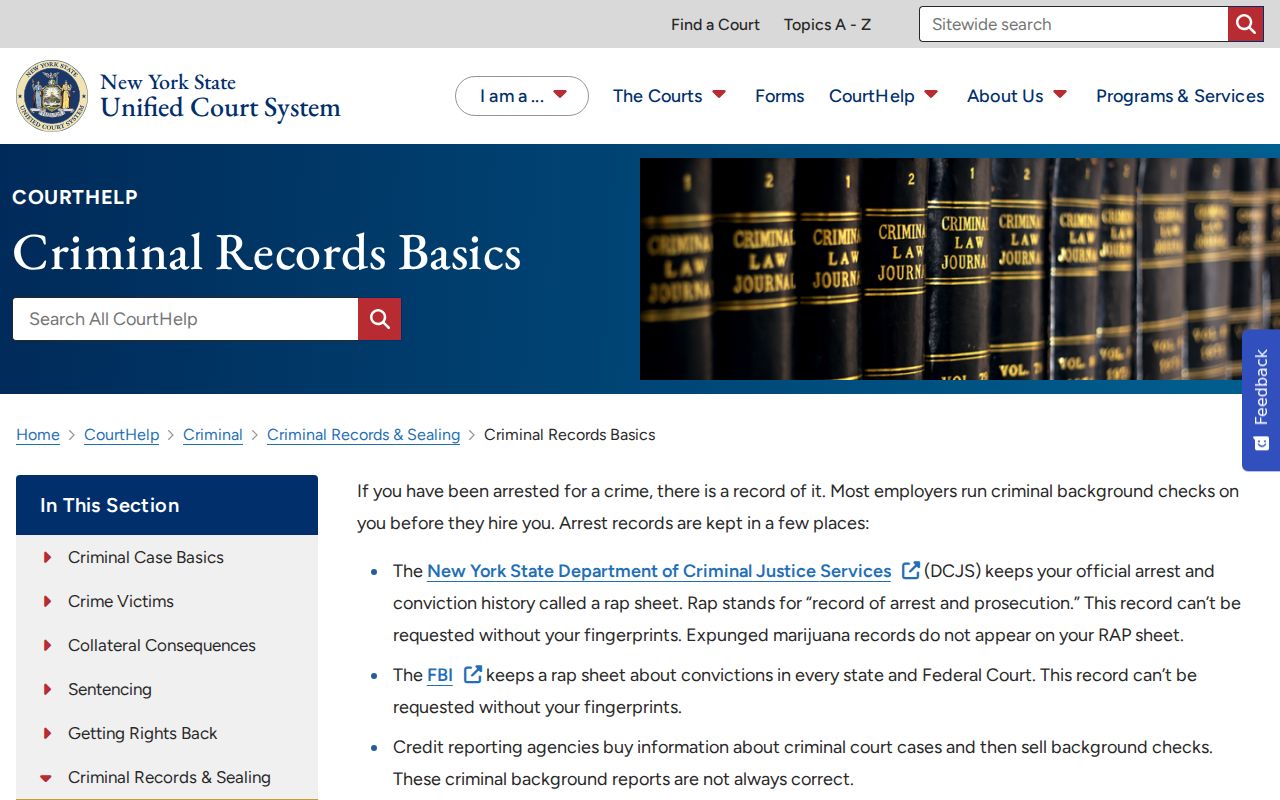
Use the court directory and CHRS as routing tools, then verify dates and outcomes against the Broome County court file.
Note: NYSCEF covers authorized e-filed matters but is not a complete Broome County criminal history portal.
What the Case File Shows
A Broome County criminal case file explains what prosecutors filed and what the judge did. It is richer than an arrest entry because the charges may change after police intake. Public records can show the accusation, counsel, release order, motion calendar, plea or verdict, judgment, and sentence. Full exhibits and protected reports are not always available online.
| Case Number & Court | The docket or indictment identifier, court, part, and county. |
|---|---|
| Charging Document | Complaint, information, felony complaint, indictment, or superior-court information. |
| Docket Entries | Arraignment, counsel, motions, hearings, pleas, trial events, and orders. |
| Hearing Dates | Past events plus the next public appearance date and part. |
| Disposition & Judgment | Outcome for each count, including conviction, dismissal, or acquittal. |
| Sentence & Conditions | Custody, probation, fine, restitution, or conditional discharge when public. |
A certificate of disposition is the clerk-certified summary of the outcome. Compare it with the initial Broome County arrest record only when tracing how police allegations became filed court counts.
Broome Clerk Criminal Case Limits
The Broome County Clerk's criminal-record FAQ warns that its office warehouses only a limited group of closed felony files. Open County Court files may still be at the court. Lower-court cases can remain with a City, Town, or Village Court or municipal hall and may never enter the County Clerk's document index.
The county's own criminal-file warning is visible in the captured source below.
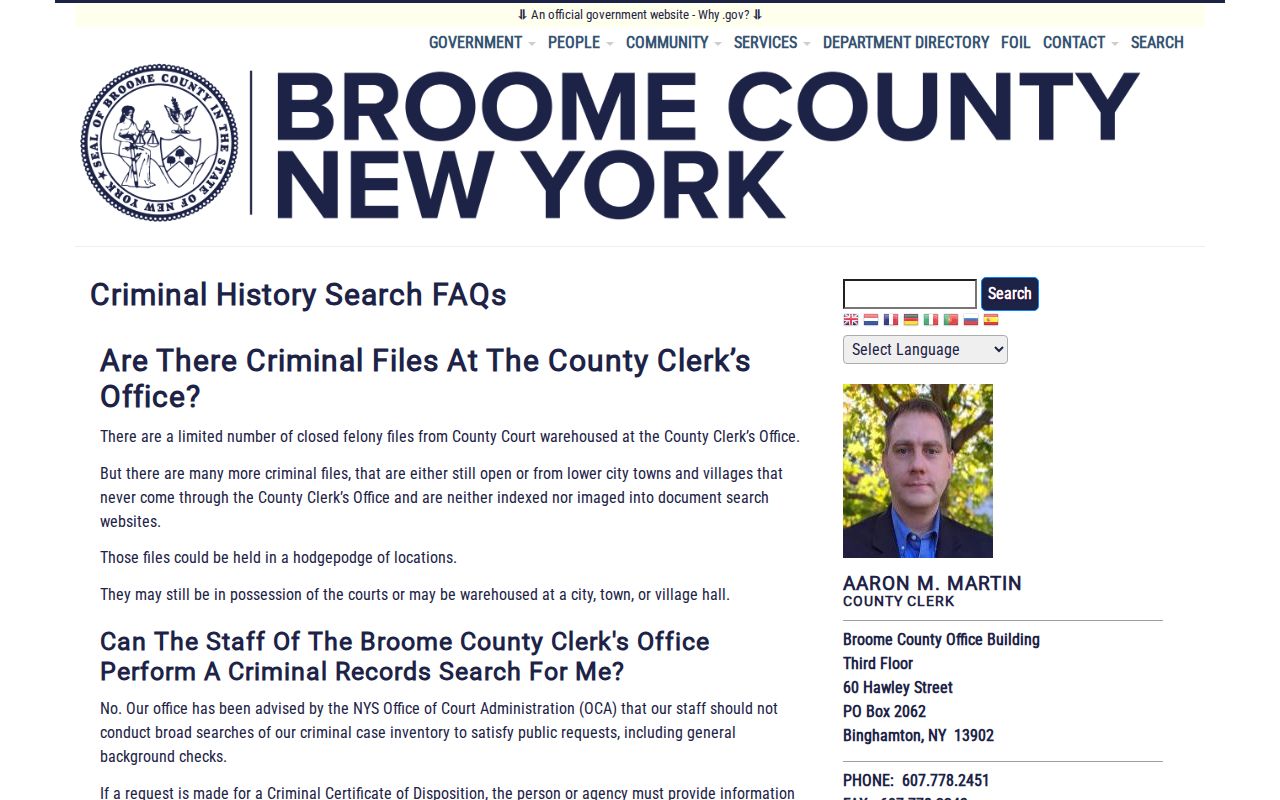
This fragmented storage is why staff will not run an undifferentiated countywide background search. Give the clerk a named defendant and known case, or use OCA CHRS to find a likely court before seeking a copy.
Stages of a Criminal Case
A Broome County felony often begins in a local criminal court. The felony complaint supports the first appearance, release decision, and counsel assignment. A grand jury may return an indictment, or a defendant may lawfully waive indictment and proceed by superior-court information. County Court then handles the felony trial-level case. A misdemeanor usually stays in the local court.
Case flow: Charges Filed → Arraignment → Pretrial → Plea or Trial → Disposition → Sentencing
Motions, discovery, hearings, and calendar changes appear between those main points. An appeal, probation term, custody record, or later sealing order can create records held by another office after the trial file closes. DCJS reported 363 Broome County superior-court arraignments in 2024, including 195 indictments and 168 superior-court informations. That figure measures one trial-level stage, not all local criminal cases and not convictions.
Broome's Centralized Arraignment Part handles first appearances when local courts are not sitting. The Public Defender keeps attorneys and investigators available for recent arrestees at all hours. The arraignment record may show counsel and release terms, while later County Court entries document discovery, motions, a plea or trial, and sentence. Read the full sequence before drawing a conclusion from one event.
Broome County Criminal Case Terms
Three labels help explain why two Broome County records can describe the same felony at different stages. Read the filed instrument before assuming the first arrest charge remained the final charge.
- Felony complaint
- The local-court document that begins a felony case before indictment or waiver.
- Indictment
- A grand-jury accusation that permits felony prosecution in County Court.
- Superior-court information
- A prosecutor-filed felony instrument used when indictment is lawfully waived.
- Disposition
- The final result of a count, such as conviction, dismissal, or acquittal.
- Certificate of disposition
- The court-certified record of the outcome, available for $5 outside New York City.
Ask the Broome County clerk to explain an unfamiliar docket label, but use the signed order or certificate as the source for the result. An event label alone may mark only one step in a case that remains open.
Broome County Cases in OCA CHRS
OCA CHRS searches public, on-file pending criminal cases and convictions reported by New York courts. It excludes sealed cases, youthful-offender adjudications, juvenile delinquency, non-criminal violations, and matters that were not reported or matched. It is a name-and-date-of-birth court search, not a fingerprint-confirmed DCJS rap sheet.
The official CHRS page is shown below.
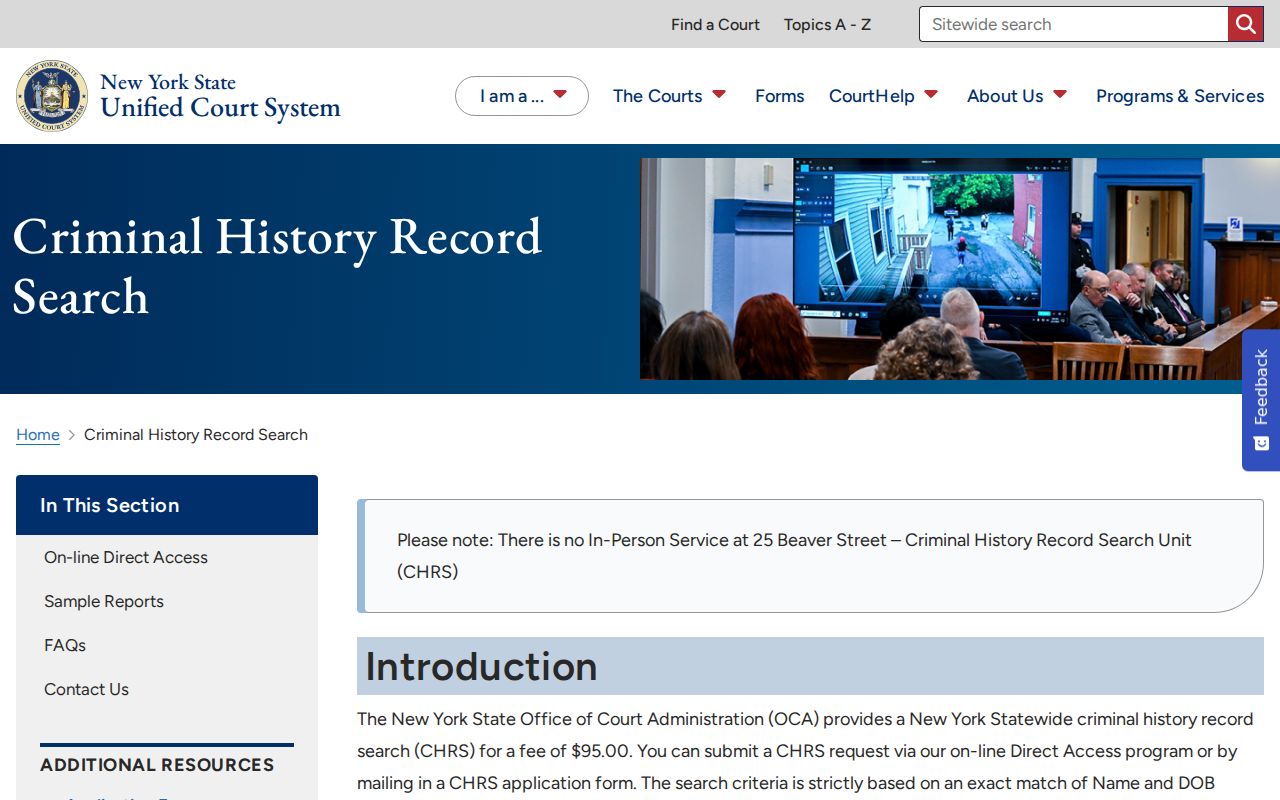
A result can identify the Broome County court, case number, charges, and reported disposition. Order the underlying docket or certificate from that court because the local file is the primary source.
Access & Restrictions
Judiciary Law §255 directs a lawful clerk search and production when required fees are paid. That rule does not override sealing. Favorably terminated actions generally seal under CPL 160.50, eligible violations under CPL 160.55, and qualifying convictions may seal under CPL 160.59 or Clean Slate. Youthful-offender adjudications and juvenile delinquency files are confidential.
Public copies can redact victim and minor identifiers, Social Security numbers, financial-account data, grand-jury material, presentence reports, and protected information. If a Broome County case does not appear, ask the originating clerk whether it is sealed, archived, transferred, or held under another docket. A defendant seeking their own statewide fingerprint record must use DCJS Personal Record Review.